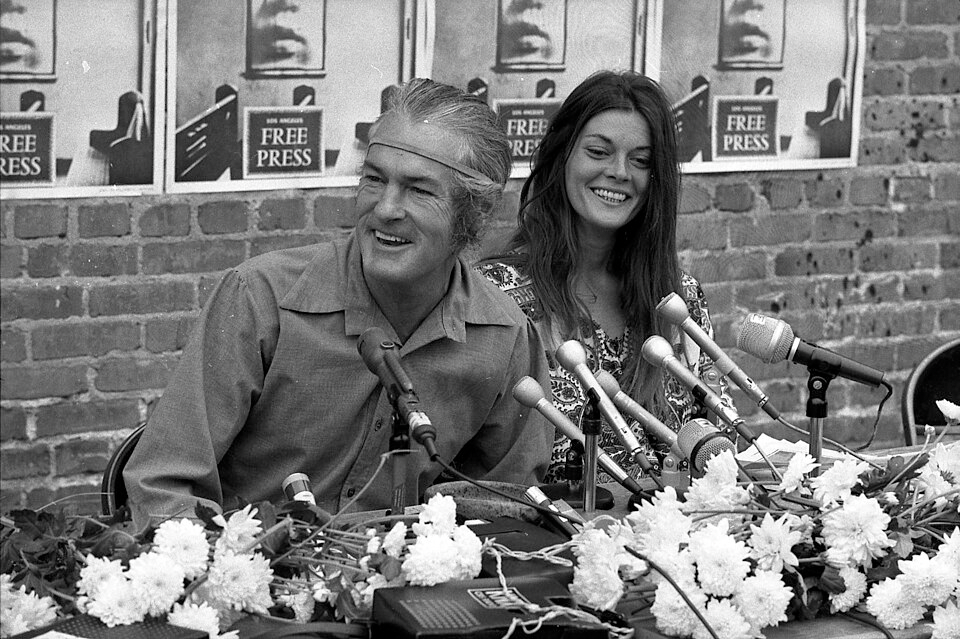
Timothy Leary
1920-1996
Turn on, tune in, drop out.
Timothy Leary was an American psychologist who taught at Harvard, where in 1960 he began the Harvard Psilocybin Project after his own experience with mushrooms in Mexico. Harvard dismissed him in 1963, partly over concerns about his research ethics. He became the public face of psychedelics, and at the Human Be-In in San Francisco in January 1967 he coined the slogan turn on, tune in, drop out. President Nixon called him the most dangerous man in America.
He was arrested 36 times in the 1960s and 1970s. His 1965 marijuana conviction was overturned by the Supreme Court in Leary v. United States in 1969. In September 1970 he escaped from a California prison. He was held in Switzerland and arrested in Afghanistan in 1972, and in 1973 he was sent to Folsom Prison. He was released in 1976 and died of prostate cancer in 1996.
The Charge
The best known case was a 1965 conviction for transporting marijuana across the Mexican border. The Supreme Court overturned it in 1969. He was later convicted of further marijuana offences in California, and his escape from prison in 1970 was a separate crime. In all, he was arrested 36 times.
The Case For
The Supreme Court overturned his 1965 conviction in 1969, in a case that struck down a federal marijuana tax law. Allen Ginsberg called him a hero of American consciousness. Psychedelic research that once ended careers has returned to universities and hospitals, and his supporters say that he opened a door the establishment slammed shut. Many of his arrests were for possession of small amounts of marijuana.
The Case Against
Harvard dismissed him partly over research ethics. His slogan encouraged young people to leave school and society behind, and critics say it contributed to casualties of the era. The Nixon administration saw him as a threat, and his escape from prison was a crime in its own right. Some researchers who returned to psychedelics say they did so under strict clinical rules, in part to avoid his example.
Where Do You Stand?
Is he the man who asked a question science later took seriously, or the man who made it harder to ask? Does the later shift in law and medicine rewrite what he did, or only the context?
Where do you stand?