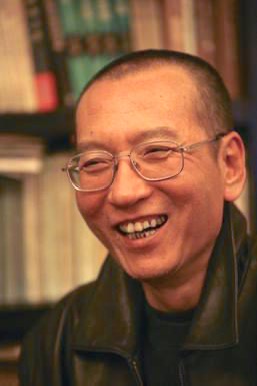
Liu Xiaobo
1955-2017
I have no enemies, and no hatred.
Liu Xiaobo was a Chinese literary critic and writer. He was arrested on 5 June 1989 after the Tiananmen Square protests and in January 1991 was convicted of counterrevolutionary propaganda and incitement, but was exempted from punishment. He helped to draft and publish Charter 08, a manifesto calling for free expression, human rights and democratic reform, and was detained on 8 December 2008. On 25 December 2009 he was sentenced to eleven years in prison for inciting subversion of state power.
In October 2010, while he was in prison, the Nobel Committee awarded him the Peace Prize. The Chinese government called the award a desecration, and censored the news. He could not attend the ceremony, and his statement was read in his absence. He was released on medical parole in June 2017 after being diagnosed with liver cancer, and died on 13 July 2017.
The Charge
He was convicted of inciting subversion of state power, based on Charter 08 and several essays published online. The trial took place on 23 December 2009, and his wife was not allowed to attend. The sentence was eleven years in prison and two years' deprivation of political rights.
The Case For
The Nobel Committee awarded him the Peace Prize for his long and non violent struggle for fundamental human rights in China. His supporters point out that Charter 08 asked for rights that China's own constitution promises, and that he was punished for words. The essay he wrote for his trial said that he had no enemies. He died in custody, and his ashes were scattered at sea.
The Case Against
The Chinese government said he was convicted under Chinese law for inciting subversion, and that foreign governments had no business interfering. It called the Nobel award wrong and a desecration of the Peace Prize. It held that the matter was a domestic judicial case. In China the verdict has never been reversed, and the government has not apologised.
Where Do You Stand?
Is a verdict that is condemned everywhere outside the country still a verdict inside it? When a state calls a manifesto a crime, which of the two is the criminal? Who gets to decide when the state itself is the one under judgment?
Where do you stand?