
Galileo Galilei
1564-1642
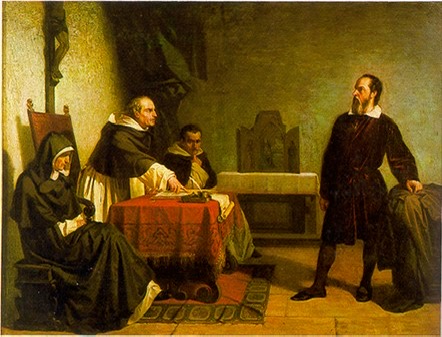
How one goes to heaven and not how heaven goes.
Galileo Galilei was a Florentine mathematician and astronomer who argued that the Earth moves around the Sun. In 1616 theologians advising the Roman Inquisition called the idea of a motionless Sun formally heretical, and Pope Paul V had Cardinal Bellarmine order Galileo to stop teaching or defending it. Books advocating the Copernican system were banned on 5 March 1616. Galileo answered in a 1615 letter to the Grand Duchess Christina by quoting a cardinal: the Bible teaches how one goes to heaven, not how heaven goes.
In 1633 he was tried for suspected heresy over his Dialogue on the two chief world systems. On 22 June 1633 he was found vehemently suspect of heresy and forced to abjure his views. The sentence of imprisonment was commuted the next day to house arrest, which lasted for the rest of his life, and his works were banned. Nearly 360 years later, on 31 October 1992, Pope John Paul II said, at the close of a Vatican study commission, that the theologians of Galileo's time had erred by reading Scripture as a physics textbook, a "tragic mutual incomprehension". It was an acknowledgement of error, and the Vatican's last word on the case.