Giordano Bruno
1548-1600
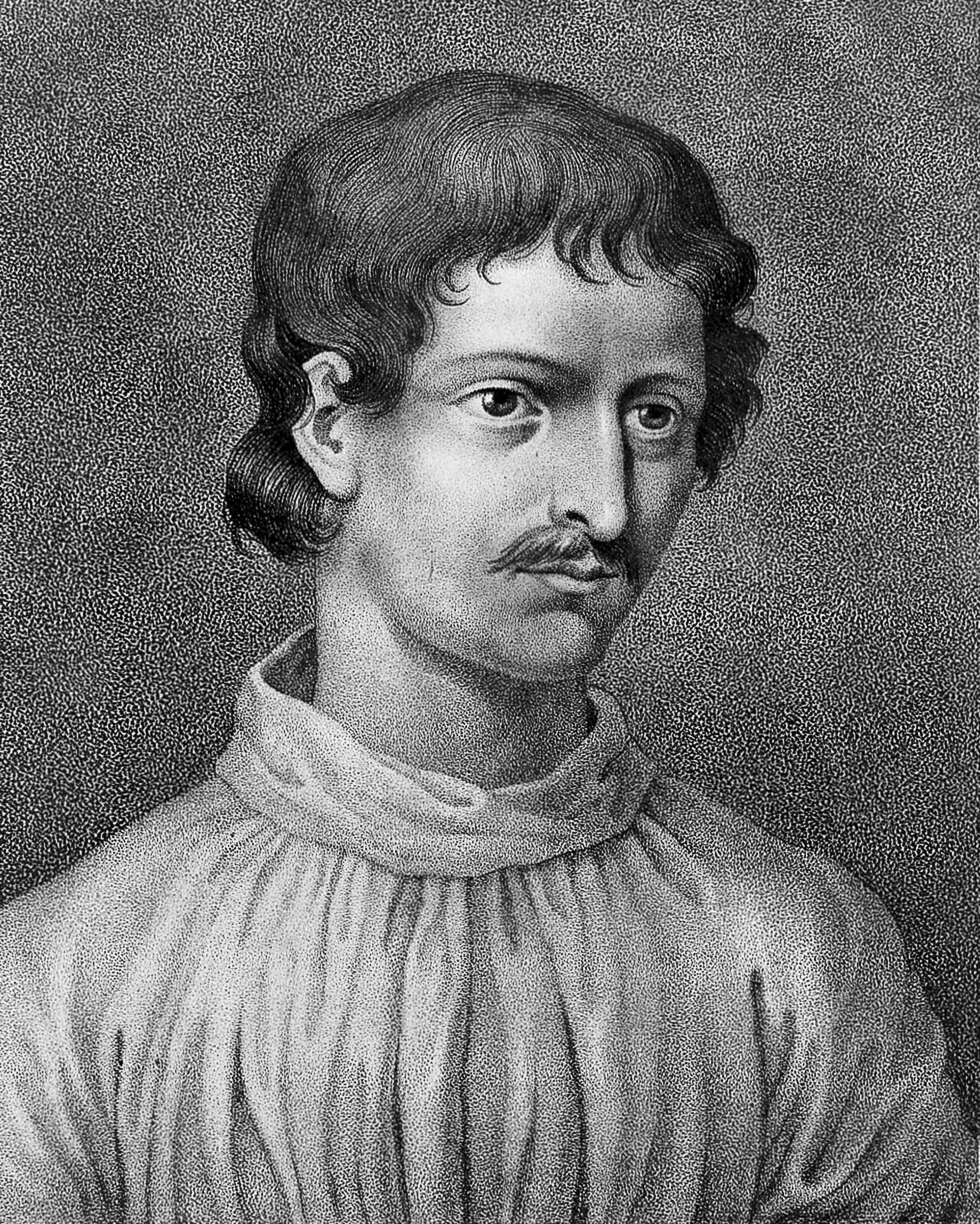
Perhaps you pronounce this sentence against me with greater fear than I receive it.
Giordano Bruno was an Italian philosopher and former Dominican friar who taught that the universe is infinite and that there are innumerable other worlds. He was arrested in Venice on 22 May 1592, after being denounced by a man who had invited him to teach, and handed to the Roman Inquisition in January 1593. He spent about seven years in prison. On 20 January 1600 he was declared a heretic, and on 17 February 1600 he was burned alive in Rome's Campo de' Fiori. His ashes were thrown into the Tiber.
In 1889 the city of Rome erected a monument to him on the place of his execution, over the opposition of the Church. The Church has never formally revoked the sentence. In 2000 a cardinal called his death a sad episode, while defending the prosecutors. The same year the Pope apologised in general terms for violence committed in the service of truth, without naming Bruno.
The Charge
The charges included denying the Trinity, the divinity of Christ, the virginity of Mary and transubstantiation, and teaching a plurality of worlds, the transmigration of souls, and magic. He refused to recant fully. The quote above, which he is reported to have said to his judges, comes from a letter by a witness, Gaspar Schopp.
The Case For
He was killed for his thinking, and the city that burned him later raised a monument to him as a martyr of free thought. He spent seven years in prison and refused to take back what he believed. Whatever the doctrinal charges, an infinite universe was part of what he taught, and he is often remembered as an early voice for the new cosmology.
The Case Against
Historians disagree about what he was condemned for. The charges were largely theological, and Copernicanism was not a heresy in 1600, as Stanford's philosophy encyclopedia notes. Some scholars argue his cosmology was only one issue among many, and that the picture of Bruno as a martyr of science is later and too neat. The Church still defends the legitimacy of the trial in its own terms, and has never retracted the verdict.
Where Do You Stand?
Was he burned for science, for religion, or for refusing to bend? If the Church today regrets the violence but not the verdict, is that an apology? And does it matter whether we get his reasons right, if we agree the punishment was wrong?
Where do you stand?