Aleksandr Solzhenitsyn
1918-2008
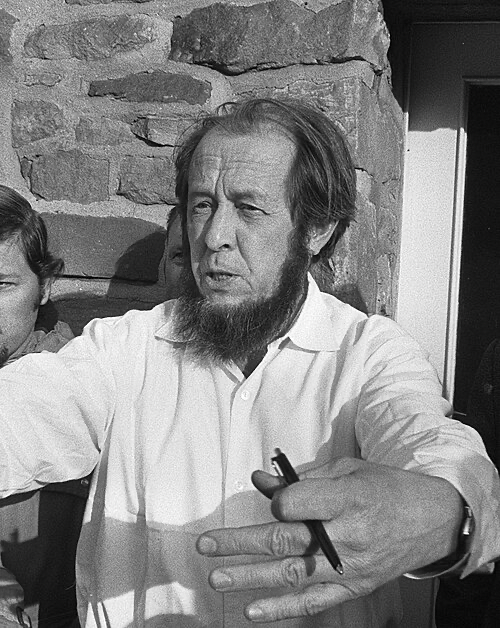
One word of truth outweighs the whole world.
Aleksandr Solzhenitsyn was an army officer arrested by the Soviet counterintelligence service SMERSH in February 1945, in East Prussia, over private letters to a friend that criticised Stalin. He was convicted under Article 58, the law on counter-revolutionary activity, and sentenced to eight years in a labour camp, part of it served at Ekibastuz in Kazakhstan. On his release in 1953 he was sent into lifelong exile in Kok-Terek, Kazakhstan. After Khrushchev's amnesty he was freed in 1956, and formal rehabilitation papers followed in 1957. He won the Nobel Prize in Literature in 1970, and The Gulag Archipelago appeared in 1973. On 12 February 1974 he was arrested again, charged with treason, stripped of his citizenship and expelled to West Germany.
His citizenship was restored in 1990. In 1991 the Soviet Prosecutor General lifted the treason charge. In May 1994 he left his home in Vermont and arrived in Moscow on 21 July. The man who had been condemned twice, once for a private letter and once for a book, was first rehabilitated and then received as a national writer.