
Thomas Jefferson
1743-1826
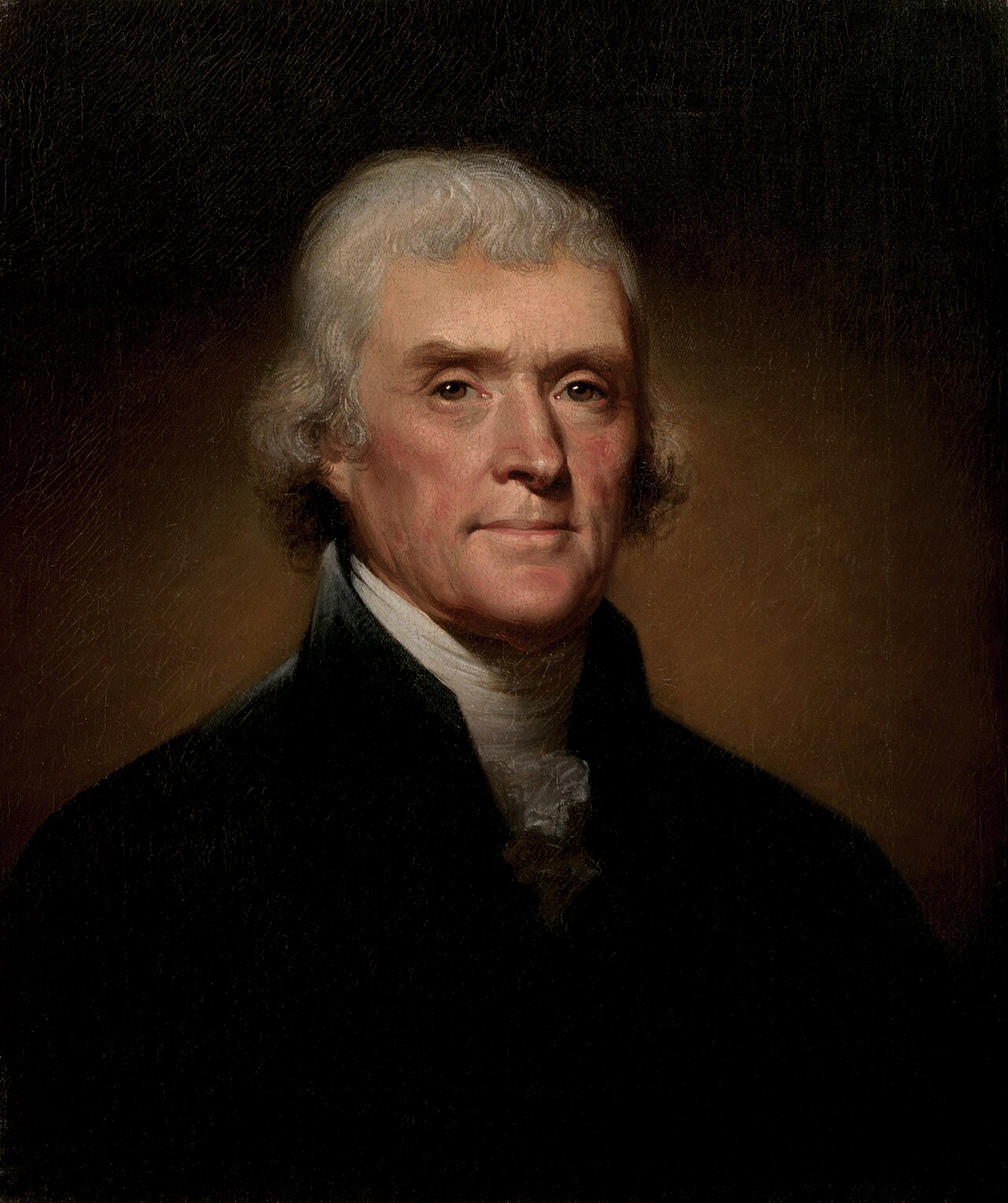
We have the wolf by the ear, and we can neither hold him, nor safely let him go.
Thomas Jefferson wrote the Declaration of Independence, with its line that all men are created equal. Over his adult life he enslaved more than 620 people. That is the whole difficulty in one sentence, and it is why he is on this site: he lived inside a system that was legal, widely accepted among his neighbours, and that the country now condemns.
The quote above comes from an April 1820 letter to John Holmes, in which he described the problem of slavery as a wolf held by the ear, a choice between justice on one side and self preservation on the other.
What Was Normal
Jefferson ran Monticello with enslaved labour. His enslaved household included Sally Hemings, the half sister of his late wife Martha. DNA evidence from 1998 linked Jefferson's male line to descendants of her son Eston, and most historians now conclude he fathered at least some, and probably all, of her children. Over his lifetime he formally freed two people, in 1793 and 1794, and his will freed five more.
Why It Seemed Right
Slavery was legal in Virginia and central to its economy. In Notes on the State of Virginia in 1785 Jefferson argued that Black people were inferior to white people, while admitting this was not certain. He favoured emancipation only together with colonization elsewhere, and warned of racial conflict if it were done otherwise. Many of his peers shared this view.
Who Objected
Some of his contemporaries opposed slavery, among them the Boston lawyer James Otis Jr. in the 1760s. Black Americans such as Richard Allen, who founded the African Methodist Episcopal Church, built institutions of their own. Two of the Hemings children simply left Monticello without any formal manumission. In his 1806 message to Congress, Jefferson himself called for an end to American participation in the slave trade, and he signed the act on 2 March 1807, which took effect on 1 January 1808.
What Changed
After Jefferson died in 1826, his debts led his family to sell about 130 enslaved people, nearly every family at Monticello, in a five day auction in 1827. Families were sometimes split apart. Slavery in the United States was ended by the Thirteenth Amendment in 1865.
Your Turn
A man can be right about liberty and wrong about people. If we judge historical figures only by whether they matched our standards, no one passes. If we excuse them by their times, nothing was ever wrong. Where do you draw the line, and what would you hope a future reader says about you?