Edward Snowden
b. 1983
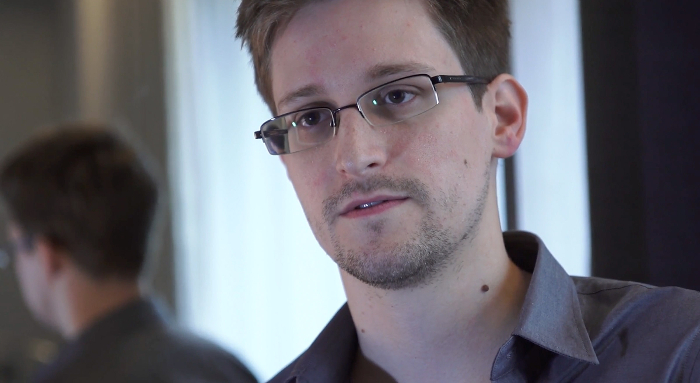
Inform the public as to that which is done in their name.
Edward Snowden was a contractor working for the US National Security Agency when, in June 2013, he gave journalists at The Guardian and The Washington Post thousands of classified documents describing government surveillance programs, including the bulk collection of Americans' phone records. He flew to Hong Kong and went public under his own name. The United States charged him within days. He then travelled to Russia, where he was granted asylum, and where he has lived ever since. In September 2022 President Putin granted him Russian citizenship.
He has never stood trial. As of the latest reporting we found (mid 2026), he has not been pardoned either, despite public calls for a pardon from across the political spectrum and Donald Trump saying in 2025 that he would look at it.
The Charge
A criminal complaint dated 14 June 2013 and unsealed a week later charged him with three offences, each carrying up to ten years in prison: unauthorized communication of national defense information, willful communication of classified communications intelligence, and theft of government property. The first two fall under the Espionage Act of 1917. Snowden says its terms would bar him from arguing that disclosure served the public interest, and the government has not offered him that option.
The Case For
In September 2020 the US Court of Appeals for the Ninth Circuit ruled in United States v. Moalin that the bulk telephone records program he exposed had violated the Foreign Intelligence Surveillance Act, and that officials' public statements about its value had not matched the classified record. In 2015 Congress passed the USA Freedom Act, which ended the NSA's bulk collection of domestic phone records, with supporters citing his disclosures. In 2014 The Guardian and The Washington Post won the Pulitzer Prize for Public Service for reporting based on his documents. He has said he would return to the United States if he could get a fair trial in which he could argue that his actions served the public interest.
The Case Against
The charges stand, and the law he is accused of breaking makes no exception for motive. In 2016 the House Intelligence Committee said he was "not a whistleblower", concluded that the leaks caused tremendous damage to national security, and accused him of misrepresenting his background; critics note that only a four page summary of its 36 page report was made public. The same Ninth Circuit ruling upheld the convictions of the defendants in the case and did not decide the constitutional question. Critics also point out that he left the country rather than face a court, and now lives under the protection of the Russian state. In 2020 a federal court awarded the US government more than 5.2 million dollars from his book and speeches for breaching his non-disclosure agreements. Supporters of reform also note that the USA Freedom Act left other programs untouched.
Where Do You Stand?
Is someone who breaks the law to expose what he believes is unlawful surveillance a criminal, a whistleblower, or both? Does it matter that he fled, that he went to Russia, or that a jury has never been allowed to decide?
Public opinion has never settled. In an April 2014 YouGov poll for The Economist, 43% approved of his leak and 45% disapproved. In a January 2014 Pew Research poll, 45% said the leaks served the public interest and 43% said they harmed it. In a January 2014 CBS News poll, 61% said he should stand trial and 23% said he should be granted amnesty. In an August 2015 Morning Consult poll, 33% supported a pardon and 43% opposed one. We found no recent national poll, so every figure here is years old.
Where do you stand?
Sources
- US files espionage charges against NSA leaker, CBS News
- Metadata collection violated FISA, Ninth Circuit rules, Lawfare
- Putin grants Russian citizenship to Edward Snowden, NPR
- Snowden is not a whistleblower, U.S. House report says, CBC
- Senate passes bill to rein in NSA phone dragnet, PCWorld
- Final judgment against Snowden over book proceeds, US Department of Justice